Submitting
Submit an email, file, URL, IP, or hash for analysis. Submissions come from the
web UI, the REST API, or the email feeder's IMAP polling. Each submission
creates a Case and dispatches Cortex analyzers automatically.
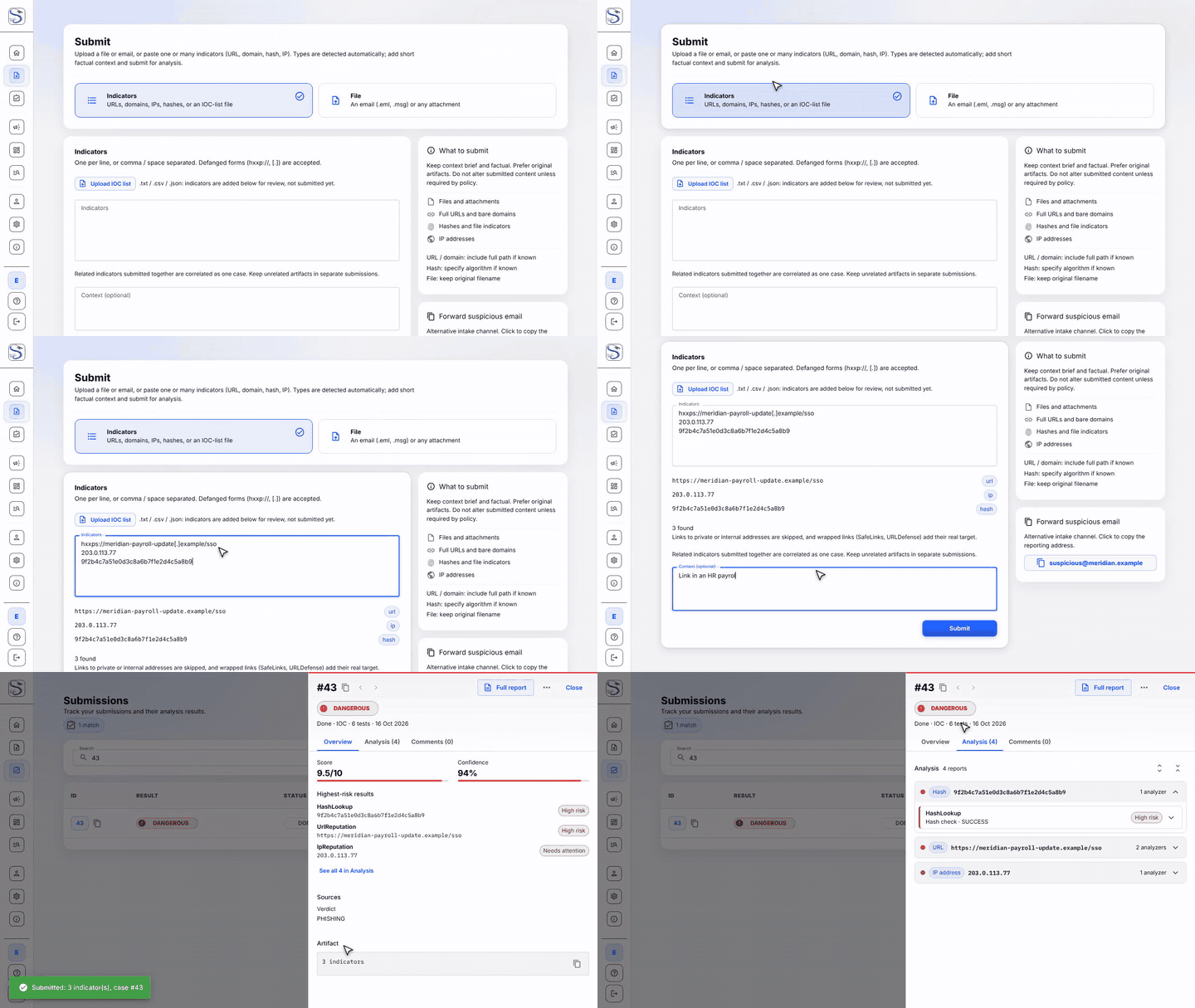
What you can submit
| Type | Notes |
|---|---|
.eml/.msg; attachments and embedded URLs are extracted and analyzed |
|
| File | Static + sandbox analysis (YARA, FileInfo, metadata) |
| URL | Direct single-URL submission always analyzes (bypasses the planner below) |
| IP | Reputation / metadata lookups |
| Hash | File-hash reputation lookup |
URLs inside a reported email
A single phishing mail can carry dozens of near-identical links (tracking variants, victim IDs, newsletter farms). To avoid flooding the case with redundant Cortex jobs, mail-extracted URLs pass through the URL analysis planner before dispatch. No URL is ever discarded — every concrete link stays recorded — but only the meaningful ones are analyzed.
Each URL ends up in one of four states:
| Status | Meaning |
|---|---|
analyzed |
Selected and sent to Cortex |
reused |
Equivalent to a URL already analyzed (same case, or a fresh prior case within the reuse window); result is shared, no new Cortex job |
skipped |
Seen but below the per-domain cap; recorded, analyzable on demand |
pending |
Queued for analysis, result not yet back |
Equivalence is by canonical key: same scheme, host (lowercased, www.
stripped), path, and the set of query-parameter names — query values and
fragments are ignored. A URL whose payload lives in the query (?url=,
?redirect=, ?token=) keeps a distinct key and is boosted by interestingness
scoring, so it is never collapsed behind benign tracking variants.
The planner is fail-open: any error on a given URL falls back to analyzing
it. It can be disabled globally with url_analysis.enabled = false
(see Configuration).
Reviewing and re-analyzing URLs
In the submission detail (Investigations), URLs are grouped by registered
domain. Each group header shows the count and status chips
(analyzed N / reused N / skipped N), sorted by interestingness. Any skipped
URL has an Analyze button that promotes it to pending and dispatches
Cortex for that single URL — useful when a capped or reused link warrants a
fresh look.
See Investigations for the full case view.